AutoEncoder
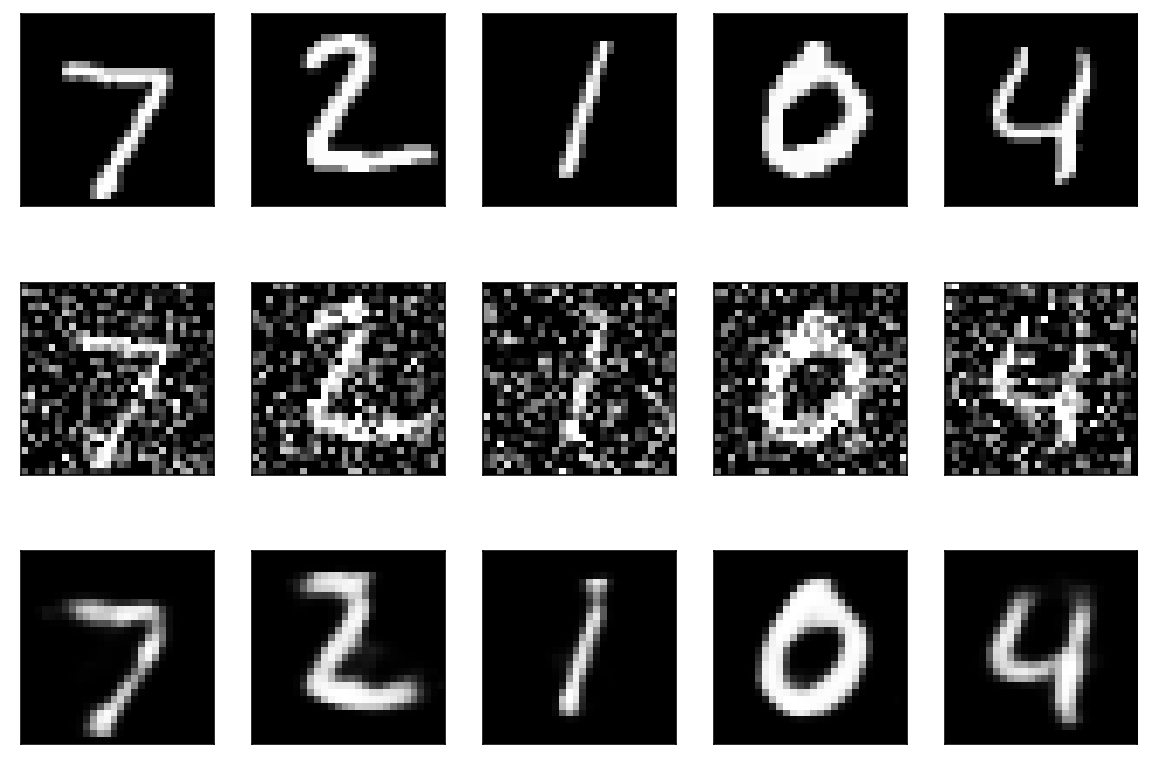
In this notebook you will find how autoencoders are trained in TensorFlow (Keras). This notebook covers two different types of encoder: a normal Auto Encoder and a Denoising Auto Encoder.
Normal Encoder
LIBRARY ARE LOADED
%matplotlib inline
%config InlineBackend.figure_format = 'retina'
import matplotlib.pyplot as plt
import pandas as pd
import numpy as np
import seaborn as sns
import warnings

warnings.filterwarnings('ignore')

#from __future__ import print_function
from keras.models import Model
from keras.layers import Dense, Input
from keras.datasets import mnist
from keras.regularizers import l1
from keras.optimizers import Adam
FOR PLOTING OUTPUTS
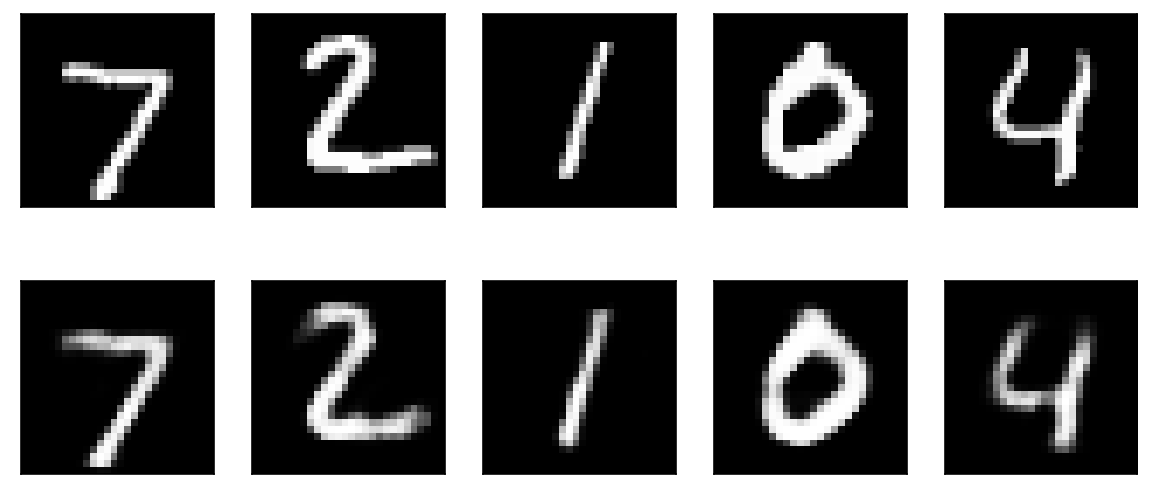
def plot_autoencoder_outputs(autoencoder, n, dims):
    decoded_imgs = autoencoder.predict(x_test)

    # number of example digits to show
    n = 5
    plt.figure(figsize=(10, 4.5))
    for i in range(n):
        # plot original image
        ax = plt.subplot(2, n, i + 1)
        plt.imshow(x_test[i].reshape(*dims))
        plt.gray()
        ax.get_xaxis().set_visible(False)
        ax.get_yaxis().set_visible(False)
        if i == n/2:
            ax.set_title('Original Images')

        # plot reconstruction
        ax = plt.subplot(2, n, i + 1 + n)
        plt.imshow(decoded_imgs[i].reshape(*dims))
        plt.gray()
        ax.get_xaxis().set_visible(False)
        ax.get_yaxis().set_visible(False)
        if i == n/2:
            ax.set_title('Reconstructed Images')
    plt.show()
TRAIN TEST SPLITS
(x_train, y_train), (x_test, y_test) = mnist.load_data()

x_train = x_train.astype('float32') / 255.0
x_test = x_test.astype('float32') / 255.0
RESIZED FOR PROCESSING
x_train = x_train.reshape((len(x_train), np.prod(x_train.shape[1:])))
x_test = x_test.reshape((len(x_test), np.prod(x_test.shape[1:])))

print(x_train.shape)
print(x_test.shape)
(60000, 784)
(10000, 784)
MODEL CREATION
input_size = 784
hidden_size = 128
code_size = 32

input_img = Input(shape=(input_size,))
hidden_1 = Dense(hidden_size, activation='relu')(input_img)
code = Dense(code_size, activation='relu')(hidden_1)
hidden_2 = Dense(hidden_size, activation='relu')(code)
output_img = Dense(input_size, activation='sigmoid')(hidden_2)

autoencoder = Model(input_img, output_img)
autoencoder.compile(optimizer='adam', loss='binary_crossentropy')
autoencoder.fit(x_train, x_train, epochs=3)
Epoch 1/3
1875/1875 [==============================] - 29s 2ms/step - loss: 0.1880
Epoch 2/3
1875/1875 [==============================] - 5s 3ms/step - loss: 0.1003
Epoch 3/3
1875/1875 [==============================] - 4s 2ms/step - loss: 0.0950
MODEL SUMMARY (ARC.)
autoencoder.summary()
Model: "model"
_________________________________________________________________
Layer (type)                 Output Shape              Param #
=================================================================
input_1 (InputLayer)         [(None, 784)]             0
_________________________________________________________________
dense (Dense)                (None, 128)               100480
_________________________________________________________________
dense_1 (Dense)              (None, 32)                4128
_________________________________________________________________
dense_2 (Dense)              (None, 128)               4224
_________________________________________________________________
dense_3 (Dense)              (None, 784)               101136
=================================================================
Total params: 209,968
Trainable params: 209,968
Non-trainable params: 0
_________________________________________________________________
MODEL OUTPUT
plot_autoencoder_outputs(autoencoder, 5, (28, 28))
MODEL TEST
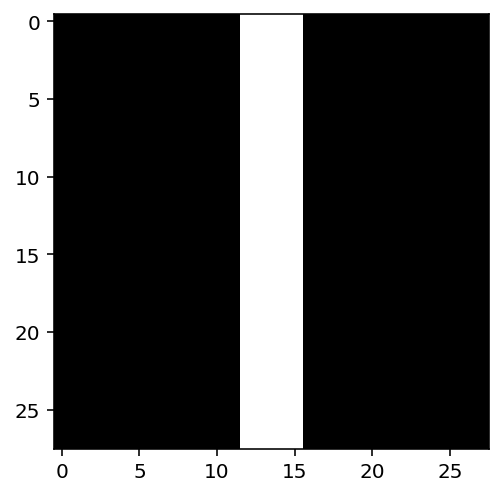
l=np.zeros((28,12))
m=np.ones((28,4))*0.8
r=np.zeros((28,12))
I=np.concatenate((l,m,r),axis=1).reshape(1,784)
plt.imshow(I.reshape(28,28))
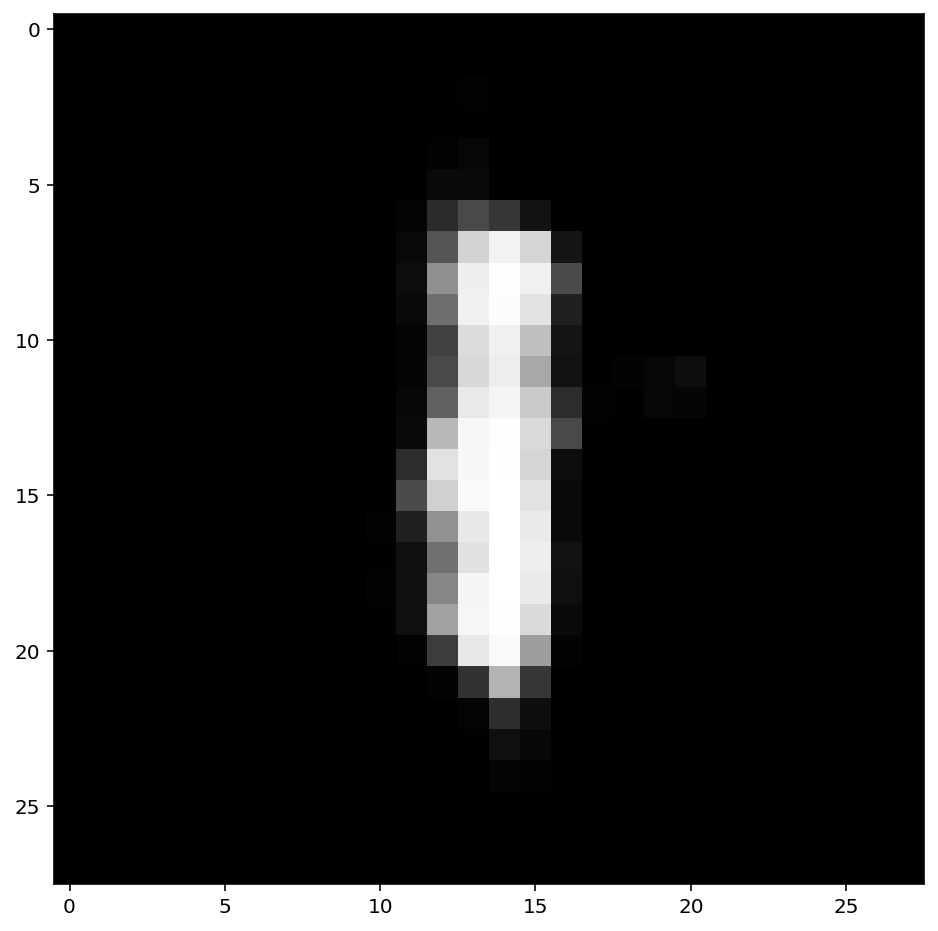
L= autoencoder.predict(I)
print(L.shape)
plt.figure(figsize=(8, 8))
plt.imshow(L.reshape(28,28))
(1, 784)
MODEL WEIGHTS VISUALIZATION
weights = autoencoder.get_weights()[0].T

n = 10
plt.figure(figsize=(20, 5))
for i in range(n):
    ax = plt.subplot(1, n, i + 1)
    plt.imshow(weights[i+0].reshape(28, 28))
    ax.get_xaxis().set_visible(False)
    ax.get_yaxis().set_visible(False)

DENOISING AUTO ENCODER
DATA CREATION
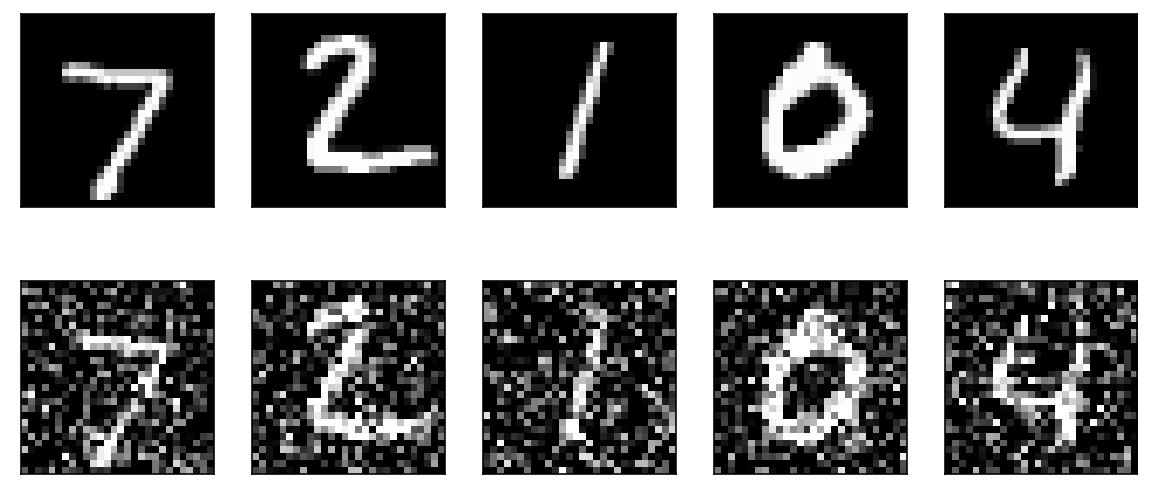
noise_factor = 0.4
x_train_noisy = x_train + noise_factor * np.random.normal(size=x_train.shape)
x_test_noisy = x_test + noise_factor * np.random.normal(size=x_test.shape)

x_train_noisy = np.clip(x_train_noisy, 0.0, 1.0)
x_test_noisy = np.clip(x_test_noisy, 0.0, 1.0)

n = 5
plt.figure(figsize=(10, 4.5))
for i in range(n):
    # plot original image
    ax = plt.subplot(2, n, i + 1)
    plt.imshow(x_test[i].reshape(28, 28))
    plt.gray()
    ax.get_xaxis().set_visible(False)
    ax.get_yaxis().set_visible(False)
    if i == n/2:
        ax.set_title('Original Images')

    # plot noisy image
    ax = plt.subplot(2, n, i + 1 + n)
    plt.imshow(x_test_noisy[i].reshape(28, 28))
    plt.gray()
    ax.get_xaxis().set_visible(False)
    ax.get_yaxis().set_visible(False)
    if i == n/2:
        ax.set_title('Noisy Input')
MODEL
input_size = 784
hidden_size = 128
code_size = 32

input_img = Input(shape=(input_size,))
hidden_1 = Dense(hidden_size, activation='relu')(input_img)
code = Dense(code_size, activation='relu')(hidden_1)
hidden_2 = Dense(hidden_size, activation='relu')(code)
output_img = Dense(input_size, activation='sigmoid')(hidden_2)

autoencoder = Model(input_img, output_img)
autoencoder.compile(optimizer='adam', loss='binary_crossentropy')
autoencoder.fit(x_train_noisy, x_train, epochs=10)
Epoch 1/10
1875/1875 [==============================] - 7s 2ms/step - loss: 0.2093
Epoch 2/10
1875/1875 [==============================] - 3s 2ms/step - loss: 0.1309
Epoch 3/10
1875/1875 [==============================] - 4s 2ms/step - loss: 0.1219
Epoch 4/10
1875/1875 [==============================] - 3s 2ms/step - loss: 0.1181
Epoch 5/10
1875/1875 [==============================] - 3s 2ms/step - loss: 0.1161
Epoch 6/10
1875/1875 [==============================] - 5s 2ms/step - loss: 0.1143
Epoch 7/10
1875/1875 [==============================] - 5s 2ms/step - loss: 0.1132
Epoch 8/10
1875/1875 [==============================] - 4s 2ms/step - loss: 0.1124
Epoch 9/10
1875/1875 [==============================] - 3s 2ms/step - loss: 0.1115
Epoch 10/10
1875/1875 [==============================] - 4s 2ms/step - loss: 0.1113
PLOTING DATA
n = 5
plt.figure(figsize=(10, 7))

images = autoencoder.predict(x_test_noisy)

for i in range(n):
    # plot original image
    ax = plt.subplot(3, n, i + 1)
    plt.imshow(x_test[i].reshape(28, 28))
    plt.gray()
    ax.get_xaxis().set_visible(False)
    ax.get_yaxis().set_visible(False)
    if i == n/2:
        ax.set_title('Original Images')

    # plot noisy image
    ax = plt.subplot(3, n, i + 1 + n)
    plt.imshow(x_test_noisy[i].reshape(28, 28))
    plt.gray()
    ax.get_xaxis().set_visible(False)
    ax.get_yaxis().set_visible(False)
    if i == n/2:
        ax.set_title('Noisy Input')

    # plot noisy image
    ax = plt.subplot(3, n, i + 1 + 2*n)
    plt.imshow(images[i].reshape(28, 28))
    plt.gray()
    ax.get_xaxis().set_visible(False)
    ax.get_yaxis().set_visible(False)
    if i == n/2:
        ax.set_title('Autoencoder Output')
WEIGHT VISUALIZATION
weights = autoencoder.get_weights()[0].T

n = 10
plt.figure(figsize=(20, 5))
for i in range(n):
    ax = plt.subplot(1, n, i + 1)
    plt.imshow(weights[i+0].reshape(28, 28))
    ax.get_xaxis().set_visible(False)
    ax.get_yaxis().set_visible(False)

Cite This Post
Auto-generated. Verify for your institution's requirements.